The Anatomy of an Overthinking Spiral: 3 Ways to Challenge The Mental Loops
Three practical, evidence-based ways to challenge those mental loops so you can reclaim your focus and your peace.
OVERTHINKING
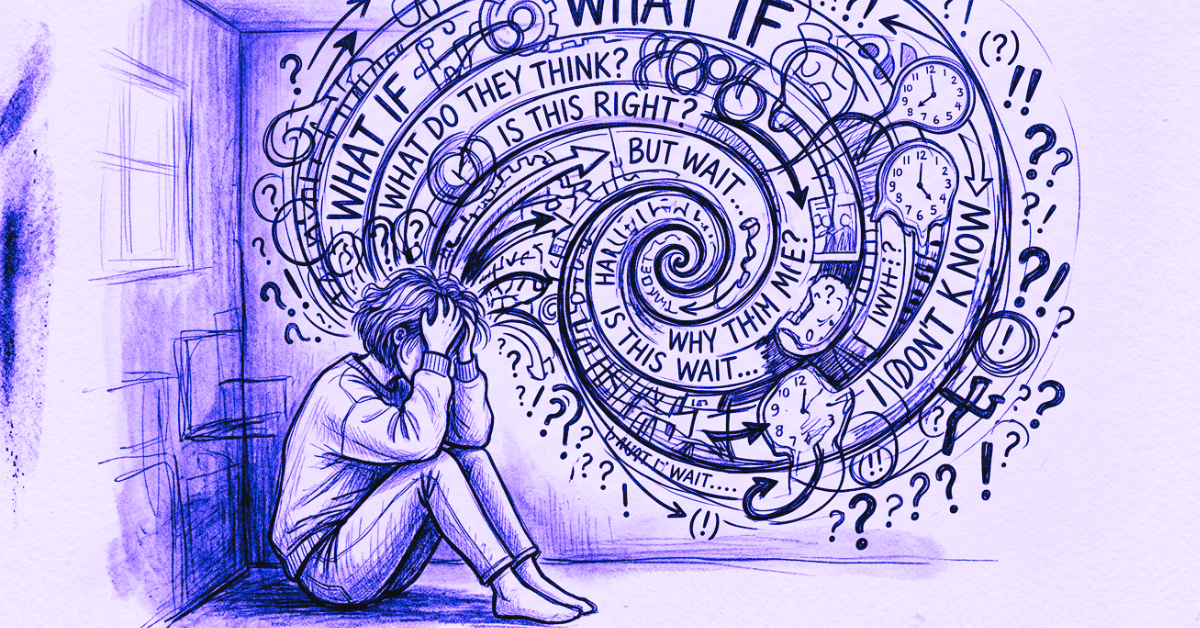
If you're a busy professional juggling deadlines, meetings, and that endless mental chatter, you probably know the feeling all too well. One minute you're reviewing a project update, and the next, your mind has spun it into a full-blown catastrophe. What if this tanks the whole quarter? What if my team thinks I'm incompetent? What if I never sleep again because of this?
As a Licensed Professional Counselor, I work with people just like you every day. High achievers who seem to have it all together on the outside, yet inside their brains run nonstop loops that leave them exhausted. You're not broken. You're not alone. And you don't have to stay stuck in these spirals.
In this post, we're going to unpack exactly how an overthinking spiral works its way into your day. Then I'll share three practical, evidence-based ways to challenge those mental loops so you can reclaim your focus and your peace. These strategies come straight from cognitive behavioral therapy, mindfulness practices, and years of helping clients quiet the noise. They're simple enough to try today yet powerful enough to create real change over time.
By the end, you'll have a clear roadmap to interrupt the cycle before it steals another hour or another night of rest. And yes, we'll keep it real with a touch of humor because sometimes the best way to face your brain is to laugh at how ridiculous it can get when it decides to play director of your personal disaster movie.
What Exactly Is an Overthinking Spiral?
Let's break it down step by step so you can see the anatomy clearly. An overthinking spiral isn't just random worry. It's a predictable pattern that hijacks your attention and turns a single thought into an all-consuming loop.
It usually starts with a trigger. Maybe it's an unclear email from your boss, a decision you need to make by Friday, or even a neutral comment from a colleague. Your brain, which is wired to scan for threats, latches on. Suddenly, that one piece of information becomes the star of an internal drama.
Next comes the automatic thought. This is where cognitive distortions sneak in. You might catastrophize by imagining the absolute worst outcome. Or you engage in mind reading by assuming everyone else is judging you harshly. These thoughts feel so true in the moment because your amygdala, the brain's alarm system, lights up like a Christmas tree. It floods your body with stress hormones and shifts you into fight-or-flight mode even though the only threat is the story you're telling yourself.
From there, the rumination kicks in. Your mind replays the scenario, asks endless what-if questions, and searches for certainty that simply doesn't exist. One thought branches into ten. Ten becomes a hundred. Before you know it, hours have passed, your shoulders are tense, your stomach is in knots, and you feel mentally drained. Sound familiar?
Here's the kicker. The more you try to think your way out of it, the deeper the spiral becomes. It's like trying to dig yourself out of quicksand by digging faster. Research in neuroscience shows that this pattern keeps the prefrontal cortex, the part responsible for clear thinking, offline while the emotional centers run the show. No wonder you end up feeling foggy, overwhelmed, and stuck.
I once worked with a client, a marketing director, who couldn't stop spiraling over a single client presentation. She replayed every slide in her head for days, convinced it would cost her the account. The anxiety spilled into her evenings and weekends until she barely had energy left for anything else. The good news? Once she learned to recognize the pattern, she could catch it early and apply the tools we're about to cover. You can too!
The beauty of understanding the anatomy is that it takes away some of the power. You start to see it as a habit your brain has learned rather than an unchangeable truth. And that perspective shift alone can create a little breathing room.
Way One: Label the Thought to Create Distance
The first way to challenge the loop is surprisingly simple yet incredibly effective. It's called labeling, and it draws from mindfulness and acceptance and commitment therapy. The idea is to step back and name the spiral for what it is, just a thought, not a fact.
Why does this work? When you label the thought, you activate the part of your brain that observes rather than reacts. It creates psychological distance, so the emotional intensity drops a notch. Instead of being swept away by the current, you become the person standing on the riverbank watching the water rush by. Studies show that this simple act reduces activity in the amygdala and strengthens your ability to respond instead of react.
Here's how to do it in practice.
First, notice the spiral beginning. Pause for a second and say to yourself out loud or in your head, "I'm having the thought that this presentation will ruin my career." Or "I'm having the thought that my colleague is upset with me."
Second, add a label like "anxiety loop" or "overthinking story." You might say, "There goes my anxiety loop again" or "My mind is writing another disaster script."
Third, observe it without judgment. Picture the thought as a cloud drifting across the sky or a leaf floating down a stream. You don't need to push it away or analyze it. Just notice it and let it move on.
Try this the next time you feel the spiral start during your commute or right before a meeting. One client of mine, a project manager, used it every time his mind began replaying feedback from his boss. He said it felt like putting his brain on mute for a few minutes so he could actually hear himself think clearly again.
Your brain loves to act like a dramatic playwright staging epic tragedies in your head.
Labeling the thought is like telling the playwright, "Thanks for the script, but I'm not casting it today." Suddenly, the show loses its grip, and you get to decide what scene comes next.
Practice this for just a minute or two at first. The more you do it, the more automatic it becomes and the less power those loops will have over your day.
Way Two: Question the Evidence Like a Detective
Once you've created some distance with labeling, it's time to challenge the story directly. This second approach comes from cognitive behavioral therapy, and it turns you into your own personal detective investigating the evidence behind the thought.
Overthinkers often accept their worries as facts without checking the receipts. Questioning the evidence interrupts that automatic acceptance and brings logic back online. It helps your prefrontal cortex get back in the driver's seat, where it belongs.
Follow these three simple questions every time the loop starts to rev up.
First, what evidence supports this thought? Be specific. Write it down if you can. For example, if you're spiraling that a team member hates your idea, list the actual facts, not the assumptions.
Second, what evidence contradicts this thought? This is the part most overthinkers skip. Look for counterexamples from past experiences or neutral data. Has something similar happened before and turned out fine?
Third, if a close friend or colleague came to me with this exact worry, what would I tell them? This question creates compassion and objectivity. You'd probably remind them of their strengths and the bigger picture rather than piling on more fear.
One busy executive I counseled used this technique during performance review season. Her mind kept looping that she would be passed over for promotion based on one minor mistake from months ago. By walking through the questions, she realized the evidence was thin at best, and the contradiction was strong; she had exceeded targets all year. The spiral lost its steam within minutes.
Your brain is basically that friend who shows up with a conspiracy theory at every gathering, convinced the coffee shop barista is plotting against them.
Playing detective lets you gently say, "Nice theory, but the facts don't add up." It's empowering, and it saves you from wasting energy on fictional plots.
Make this a quick habit. Keep a note on your phone with the three questions so you can pull it up anytime. You'll be amazed at how fast the mental volume turns down when you treat thoughts like hypotheses rather than gospel truth.
Way Three: Anchor in the Present with a Quick Sensory Reset
The third way shifts you out of your head and into your body, where the present moment lives. This sensory reset combines elements of mindfulness and behavioral activation to break the loop by engaging your senses directly. Overthinking thrives in the abstract future or past, but it struggles to survive when you're fully here right now.
This technique works because it activates your parasympathetic nervous system, the rest-and-digest mode that calms the stress response. It also gives your mind a concrete task so it can't keep spinning abstract worries.
Here's the easy four-step process you can do anywhere:
First, stop and notice five things you can see around you right now. Name them silently. The blue folder on your desk, the plant in the corner, whatever is in your line of sight.
Second, name four things you can touch. Feel the texture of your chair, the fabric of your shirt, or the cool surface of your desk.
Third, identify three sounds you hear. Maybe the hum of the air conditioner, traffic outside, or your own breathing.
Fourth, finish with two things you can smell and one thing you can taste. If nothing is handy, take a slow breath and notice the air or sip some water.
Do this for sixty to ninety seconds max. It's quick enough for a busy schedule yet effective enough to reset your entire nervous system.
I remember a client, a sales leader, who used this reset before every big client call. His mind would spiral about potential objections and rejection until he started the sensory exercise. Within weeks, he reported feeling more grounded and present during conversations, which actually improved his performance.
Think of your overthinking brain as that overly enthusiastic toddler who refuses to stay in the playpen. The sensory reset is like handing the toddler a shiny new toy. It gets distracted just long enough for you to catch your breath and choose your next move.
Use this one when the spiral feels too intense for labeling or questioning alone. It's especially helpful at night when your mind decides three in the morning is the perfect time for a worry festival.
Putting These Tools into Your Daily Routine
You don't need to master all three ways at once. Start with the one that feels easiest and build from there. Maybe label the thought during your morning coffee, then question the evidence before lunch, and finish the day with a sensory reset if things heat up.
The real magic happens in the consistency. These aren't one-and-done fixes but skills that get stronger with practice. Over time, you'll notice the spirals start later, last shorter, and feel less overwhelming. You'll sleep better, focus sharper, and enjoy your life more because your energy is no longer tied up in mental loops.
Remember, progress isn't about never having another spiral. It's about catching it sooner and having the tools to respond with kindness and skill. You've already taken the first step by reading this far. Give yourself credit for that.
If this resonated with you and you want more tips like these delivered straight to your inbox every week, I invite you to subscribe to my newsletter, The Mental Freedom. It's written specifically for busy professionals who want to quiet the overthinking without adding more to their plate. Each issue takes about five minutes to read and leaves you with one practical tool you can use right away.
Join the community of folks who are reclaiming their mental space one small shift at a time. You've got this!
Good day and good night, John Cordray, LPC
© 2026. John Cordray, LPC. All rights reserved. Privacy Policy Terms & Conditions Contact